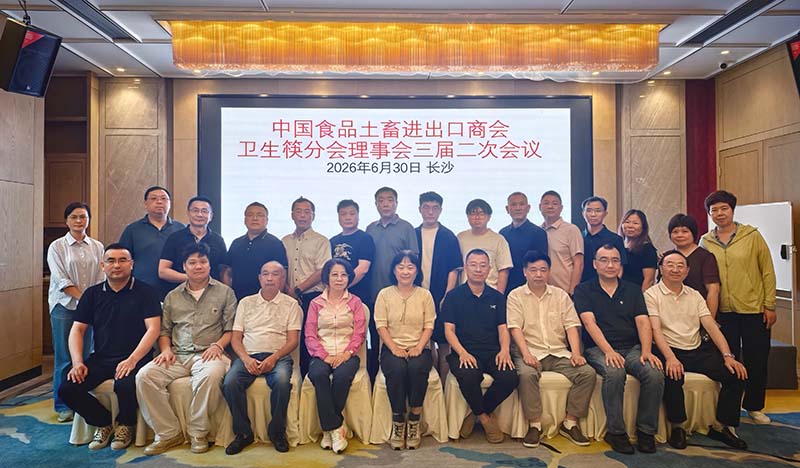
On June 30, 2026, the Second Meeting of the Third Council of the Disposable Chopsticks Branch of the China Chamber of Commerce for Import and Export of Foodstuffs, Native Produce, and Animal By-Products was grandly convened in Changsha, Hunan. Representatives from 15 leading enterprises in key production areas and trade ports—including Hunan, Jiangxi, Guangxi, Fujian, and Dalian—gathered to engage in in-depth discussions on core issues such as the current international trade landscape for the disposable chopsticks industry, market competition dynamics, the development of national standards, and trends in industrial investment.
The meeting was presided over by the Branch Council. Against the backdrop of the current global push for green and sustainable packaging, this gathering served not only as a “mid-year review” of the industry’s status but also as a “forum for voicing concerns” regarding the industry’s high-quality development and the maintenance of a healthy competitive environment.
I. Data Analysis: Customs Export Data Reflects New Competitive Landscape
The meeting began with a special presentation by the Chamber of Commerce Secretary-General. The Secretary-General presented a comparison of customs export data for the first half of 2026 with that of the same periods in the past two years (the first halves of 2024 and 2025).
The data clearly illustrates the fluctuations in demand and price trends for disposable chopsticks and bamboo and wood products in the international market over the past three years. Citing the data, the Secretary-General noted that while the total demand for eco-friendly tableware in some overseas markets remains substantial, export growth has leveled off due to adjustments in global supply chains and the impact of the external economic environment. More importantly, because of structural overcapacity in the domestic market, enterprises are facing increasingly fierce price wars in overseas markets, and the traditional model of “increasing volume while lowering prices” is no longer sustainable.
II. A Rational Assessment: While “Replacing Wood with Bamboo” Is a Good Policy, We Must Be Vigilant Against Excessive Duplicate Investment
Delegates engaged in a lively discussion regarding the surging investment boom in the domestic bamboo industry. The “Replacing Wood with Bamboo” policy, which has been vigorously promoted at the national level in recent years, has undoubtedly opened up vast opportunities and policy benefits for the bamboo products industry. However, Council representatives have keenly detected signs of market “overheating” in practice.
The participating enterprises unanimously agreed that:
“Replacing Wood with Bamboo” is a sound policy aligned with the advancement of ecological civilization; however, at the implementation level, some local governments have blindly pursued industrial development and engaged in excessive, repetitive investment in low-end bamboo industries. This has led to a concentrated surge in low-end production capacity in the short term, severely disrupting the supply-demand balance in the market.
Accordingly, the Council formally proposed an initiative, urging relevant departments to actively guide and advise local governments to exercise self-restraint in curbing blind, bandwagon-style investment in low-end bamboo industries. The industry should transition toward high value-added products, technological innovation, and deep processing, rather than engaging in “counterproductive internal competition” over low-end, homogeneous products.
III. Industry Recommendations: Two Key Demands to Safeguard a Healthy Competitive Environment
To fundamentally address the current situation of “bad money driving out good money” through institutional and market reforms, the Council reached a strong consensus and will submit two important proposals to the relevant national ministries and commissions:
● Propose the elimination of export tax rebates for bamboo chopsticks to curb malicious low-price competition
Some small and medium-sized enterprises have long relied on export tax rebates to engage in low-price dumping, leading to disorder in the international market and a decline in the industry’s overall profit margins. The Council recommends that relevant authorities consider abolishing export tax rebates for bamboo chopsticks. By leveraging market mechanisms, enterprises will be compelled to improve product quality and management efficiency, while marginal production capacity that relies on subsidies will be phased out, thereby maintaining a healthy, resilient, and fair competitive environment for foreign trade.
● Requesting the Revision or Establishment of New Product Standards to Raise Industry Entry Barriers
As production processes and international safety standards for food-contact materials continue to evolve, current standards for bamboo chopsticks can no longer fully meet the industry’s needs for quality control and market regulation. The Council has formally requested relevant authorities to revise existing national standards for bamboo chopsticks or to expedite the development of new industry and association standards. By raising technical and safety thresholds, the Council aims to regulate market competition and ensure consumer safety.
Conclusion
Amid severe industry challenges, this Changsha conference demonstrated the sense of responsibility and commitment of leading enterprises. Attendees unanimously agreed that after decades of export-oriented development, the disposable chopstick industry is now at a critical crossroads, moving toward high quality and high standards. The Chamber’s Disposable Chopstick Branch will use this meeting as an opportunity to closely unite enterprises across major production regions, actively serve as a bridge between the government and businesses, and properly submit the four core consensus points and requests from this meeting, so that the industry can collectively embrace a new phase of rational recovery and green, healthy development.